From Red Cross to responsible mining: Oyunbolor Tserenkhuu’s journey towards sustainability
Нийтэлсэн: 2026-01-8
Oyunbolor Tserenkhuu, Lead Economist of the Planning and Economic Analysis Division at Erdenet Mining Corporation (EMC), is driving a transformative shift in Mongolia’s mining sector using her new knowledge gained from participating in the Australia Awards – South Asia & Mongolia Carbon Conscious Mining Mongolia Short Course.
Delivered by The University of Queensland’s (UQ’s) Sustainable Minerals Institute and International Development unit, and funded by the Australian Government’s Department of Foreign Affairs and Trade, the course empowered participants to apply global sustainability insights to local challenges. For Oyunbolor, it was a turning point.
“This project is very important to me because it opens a new page in my professional journey – both within Erdenet Mining Corporation and personally,” she said.
Oyunbolor joined EMC 5 years ago, bringing a background in financial management, business administration and social work. Her early career with the Mongolian Red Cross Society and UNICEF shaped her belief that development must improve lives in tangible ways – an ethos that now drives her work in mining economics.
“As Lead Economist, my main responsibility is to project the financial and economic impacts of major capital projects and assess how our investments affect both local communities and the national economy,” she explained. After two years of research and collaboration, Oyunbolor’s team published EMC’s first-ever Sustainable Development Report – a milestone she is proud of and one that reflects the efforts of many dedicated colleagues.
Following the report and Oyunbolor’s participation in the Australia Awards Short Course, she identified a critical gap in EMC’s longstanding tree-planting program: the absence of a carbon-sequestration Monitoring, Reporting and Verification (MRV) system – a concept still new in Mongolia. As a key outcome of the Australia Awards Short Course, Oyunbolor developed a Return-to-Work Plan that focused on measuring the carbon sequestration potential of EMC’s ‘One Hundred Million Trees’ initiative. This initiative is part of Mongolia’s national Billion Tree Program, a nationwide campaign to restore forest ecosystems and combat climate change through large-scale tree planting.
“This course inspired me to establish the MRV system for carbon sequestration from EMC’s tree initiative – something that had not yet been developed at our company,” Oyunbolor said.
Her Plan aims to build a scalable carbon-modelling framework for EMC’s broader reforestation efforts. It also considers co-benefits, such as economic and social impacts, aligning with EMC’s sustainability strategy.
“This Return-to-Work Plan could become a strategic priority because it provides evidence-based insights to guide management decisions, inform stakeholders, and ensure the program’s contributions are fully recognised and communicated,” she said. “Through this Plan, I hoped to initiate an evaluation process for longstanding, high-impact initiatives, enabling the company to provide measurable results that clearly demonstrate their tangible social and environmental benefits.”
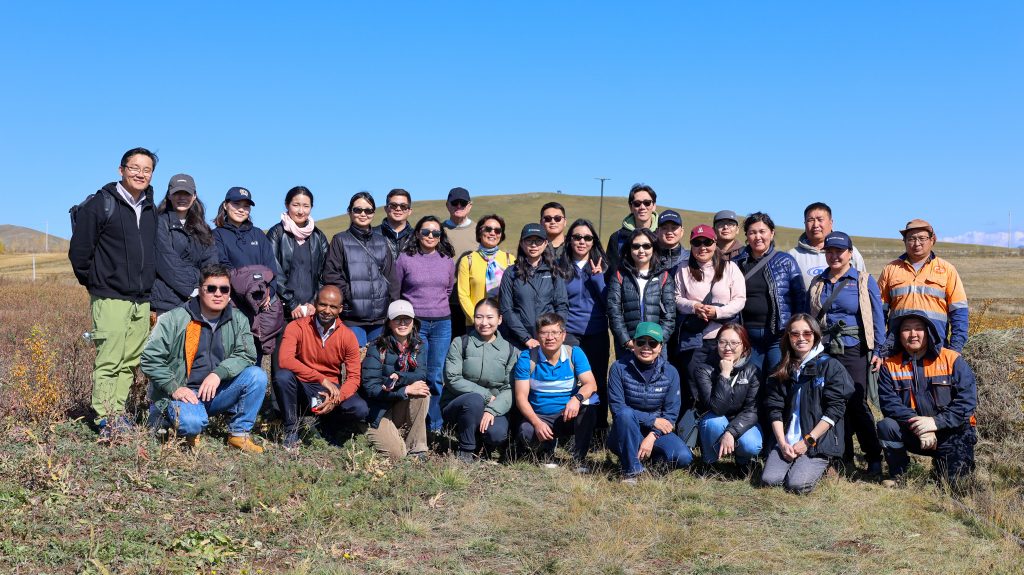 Dr Byambajav Dalaibuyan, Research Manager at the Centre for Social Responsibility in Mining at UQ’s Sustainable Minerals Institute and one of the designers and leaders of this Australia Awards Short Course, echoes the importance that the Return-to-Work Plan plays as a core element of the course.
“It enables participants to translate new learning into practical action, applying their enhanced skills and knowledge to create meaningful change within their organisations – and more broadly across their sectors and communities,” Dr Dalaibuyan said.
Oyunbolor’s Plan not only supports EMC’s internal sustainability goals but also contributes to Mongolia’s Nationally Determined Contributions under the Paris Agreement. If implemented as a community-based project, the initiative could create local employment, improve environmental conditions, and deliver long-term benefits to rural communities – including herder households, women, youth and ethnic minorities.
“To me, sustainable mining is about finding harmony between economic growth and environmental stewardship, between social responsibility and long-term prosperity,” Oyunbolor said. “It’s about ensuring that the resources we extract today continue to benefit our people, our communities and our environment far into the future.”
Through her leadership and vision, Oyunbolor is helping shape a more sustainable future for Mongolia’s mining sector – one tree, one plan and one community at a time.
Related Work
UQ’s Centre for Social Responsibility in Mining (CSRM) also delivered a training program to build Mongolia’s capacity for sustainable mining and support its green energy transition, through the Australia–Mongolia Partnership.
For more information on the CSRM program delivered by UQ International Development: Australia and Mongolia are addressing energy challenges through Australia Awards Fellowships.
UQ International Development (UQID) work in Mongolia
Since 2021, UQID has delivered 8 Australia Awards Courses in Mongolia, reaching over 125 participants across Australia and Mongolia. These courses have included Carbon Conscious Mining, Women in STEM, Women in Executive Leadership, Women in Agriculture, Women’s Leadership Program and, in 2024, the first Australia Awards Fellowships for Mongolia.
Reference
The University of Queensland, Global-Partnerships. “From Red Cross to Responsible Mining: Oyunbolor Tserenkhuu’s Journey towards Sustainability.” Uq.edu.au, 7 Jan. 2026, From Red Cross to responsible mining: Oyunbolor Tserenkhuu’s journey towards sustainability – Global Partnerships – University of Queensland. Accessed 8 Jan. 2026.